ECONstance Insights
ECONstance Insights is a monthly, online-only publication series providing structured economic analysis of current developments in international markets and economic policy.
ISSN: 3055-9235 (online)
Issues and Archive

Cheap Capital: The End of an Era
Higher Rates, Changing Expectations and the Consequences for the Global Economy
The Federal Reserve's September rate increase and higher projections make a rapid return to cheap refinancing a weaker basis for investment planning. Existing contracts delay the adjustment: borrowers with low fixed-rate loans often face higher interest costs only when their debt matures. Those costs can therefore keep rising after central banks stop raising rates.
The effects on households and firms depend on lending contracts, banking systems and currency exposure. The report examines these differences in the United States and European Union, followed by Brazil, Türkiye, Japan and China. It explains why domestic rate cuts may offer limited relief from more expensive dollar funding, and why low nominal rates may do little to stimulate investment when demand is weak. The consequences extend to the choice of investment projects and the organisation of supply chains: long construction periods, inventories and additional suppliers tie up capital whose financing costs can change for years to come.
Download PDF →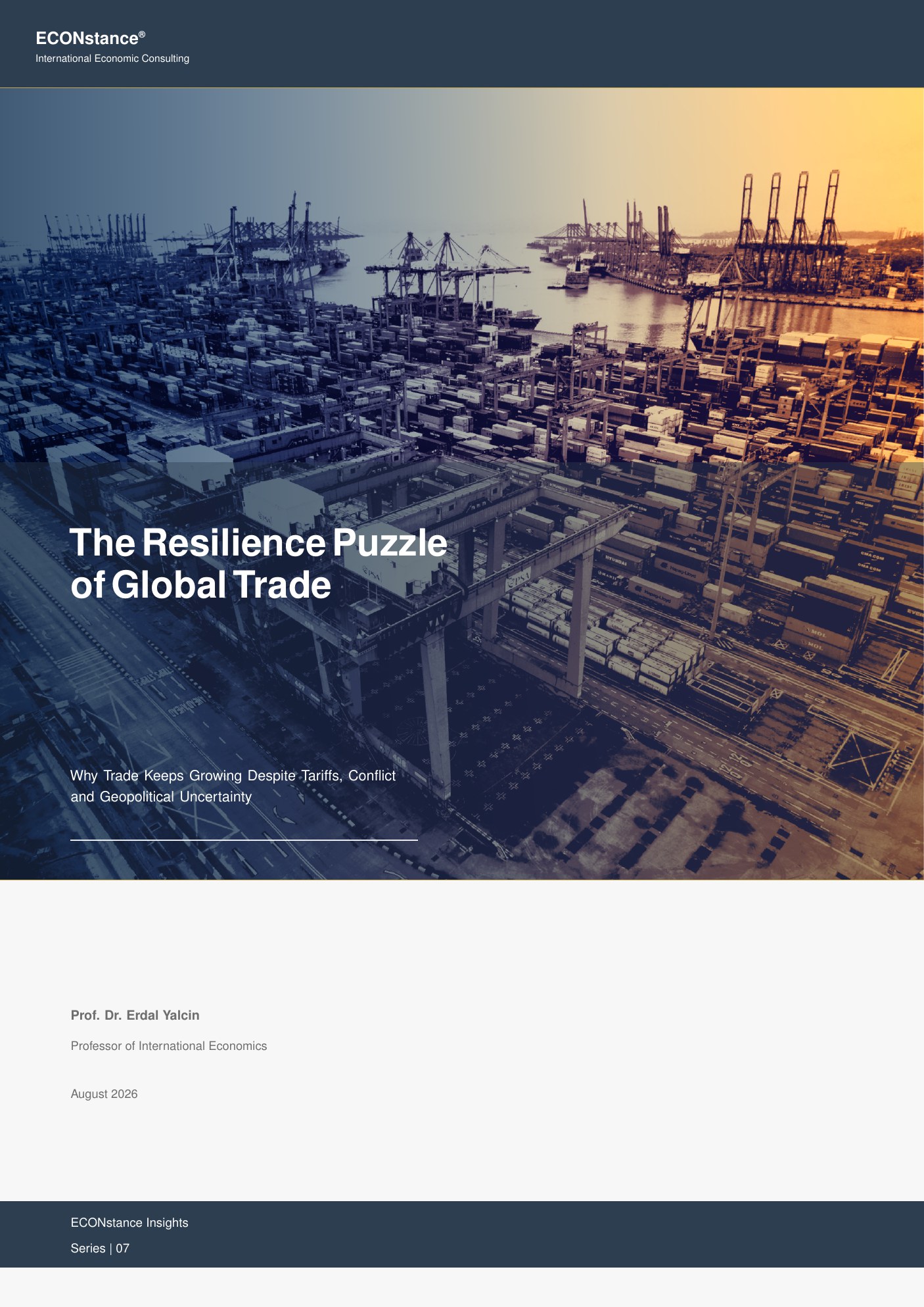
The Resilience Puzzle of Global Trade
Why Trade Keeps Growing Despite Tariffs, Conflict and Geopolitical Uncertainty
By every conventional measure, 2025 should have been a disastrous year for world trade. Trade policy uncertainty rose to ten times its previous-decade average, the US average tariff climbed from 2.6 percent to roughly 13 percent, and the WTO initially forecast a contraction. Instead, world merchandise trade volume grew by 4.6 percent and the value of global trade exceeded US$35 trillion. This report explains the puzzle through three layers of resilience: front-loading and inventory accumulation borrowed demand from the future; trade in AI-enabling goods created an exceptional new growth engine; and firms rerouted supply chains through connector economies while the multilateral trading baseline remained largely intact. Yet resilient volumes do not mean that uncertainty is costless. Its burden appears in higher prices, longer and less efficient routes, growing compliance complexity and forgone investment. By treating trade as a portfolio of relationships, the report shows why concentration becomes costly when geopolitical risks are correlated and why diversification, dual sourcing and route redundancy are rational investments in resilience.
Download PDF →
Baden-Württemberg in Transition
How the Land of Hidden Champions Navigates the Twin Transformation of Its Industrial Core
Few regional economies have converted engineering excellence into prosperity as systematically as Baden-Württemberg. This issue examines how the German southwest is being forced to adapt as its automotive core, energy cost base and export-oriented business model are hit at the same time by electrification, decarbonisation and geoeconomic fragmentation. The report argues that the region’s challenge is not a lack of assets: its R&D intensity, dual training system, family-owned hidden champions and emerging AI and transfer infrastructure remain exceptional. The decisive question is whether firms and policy makers can convert specialised industrial excellence into faster networked cooperation, shared data infrastructures, industrial AI deployment, supplier conversion and more resilient market strategies before the window for adaptation narrows.
Download PDF →
Africa: The Continent of the 21st Century?
Growth, Challenges, and the New Global Competition for Economic Integration
For decades, economic discourse on Africa has swung between fatalistic pessimism and unbridled optimism — and neither caricature survives contact with the data. By sheer demographic weight, Africa is the continent of the 21st century: its population will approach 2.5 billion by 2050 at a median age of nineteen, supplying more than half of all global population growth. The central thesis of this report is that "Africa" as a singular economic entity does not exist — its fifty-four economies diverge so sharply in growth, governance and creditworthiness that any pan-continental strategy is mispriced. High-growth hubs in East and West Africa compound at 5–7 percent, while the traditional heavyweights — Nigeria, South Africa and Angola — remain trapped in low-growth equilibria. Four forces define the decade ahead: demography, a digital-payments leapfrog, the critical-minerals endowment underpinning the green transition, and a new geoeconomic scramble among China, the EU and the United States — all set against a sovereign-debt crisis, a vast infrastructure-financing gap and Sahelian fragility. Engaging with the continent therefore demands hyper-localised strategies rather than continental generalisations, because the decisive question is no longer whether Africa will matter, but who will hold the value when it does — and on whose terms.
Download PDF →
The Route Question: Asia-EU Connectivity in an Age of Geopolitical Competition
Five Corridors, Five Sponsors, and the Race for the World's Most Strategic Trade Routes
The stable two-route architecture that long governed Asia-EU trade — the Trans-Siberian Northern Corridor for overland freight and the Suez Canal for maritime cargo — has been dismantled by two shocks in barely eighteen months: Russia's war against Ukraine and the Houthi campaign in the Red Sea. The central thesis of this report is that the search for alternative arteries is not primarily a logistics optimization exercise but a geopolitical contest. Each of five routes — the Middle Corridor, the International North-South Transport Corridor, IMEC, the Belt and Road Initiative and the Cape of Good Hope — has a primary sponsor whose strategic interests shape its design, governance and chances of completion. None is yet ready to absorb the displaced freight at the scale and reliability global trade requires, leaving firms and policymakers to navigate a fragmented and politically contested logistics landscape.
Download PDF →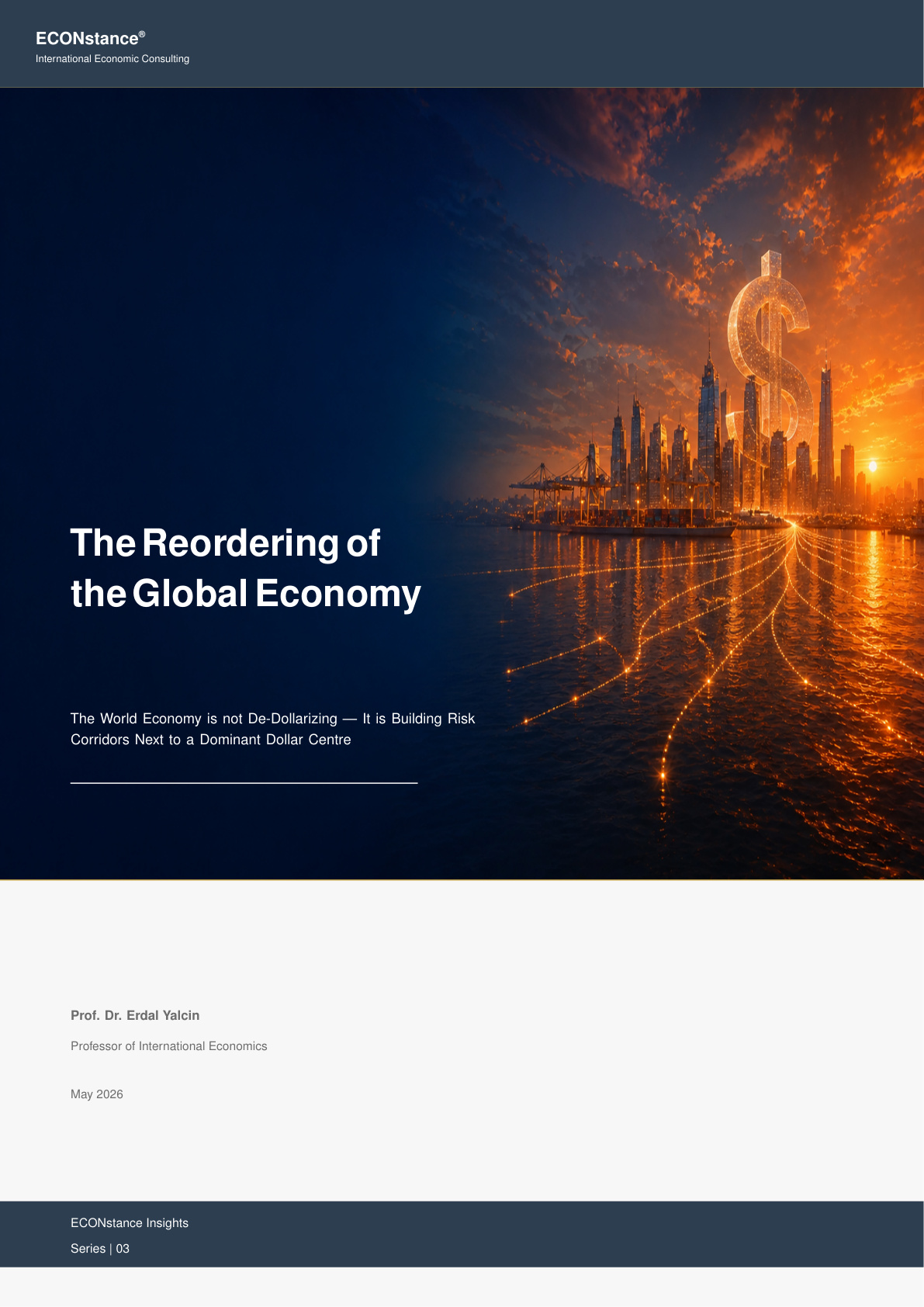
The Reordering of the Global Economy
The World Economy is not De-Dollarizing — It is Building Risk Corridors Next to a Dominant Dollar Centre
The global economy is undergoing a structural transformation across three constitutive dimensions: trade has become more restricted and regionally organized; finance has begun to fragment into parallel payment rails and alternative reserve arrangements; and the institutional architecture of multilateralism has been hollowed out at its core. The central thesis of this report is that the world economy is not de-dollarizing — it is building risk corridors next to a continuing dollar centre. Dollar centrality persists, but dollar exclusivity has weakened, and firms and states are increasingly constructing corridor-specific risk-management architectures alongside their continued use of dollar-based instruments. This report examines the empirical record across all three dimensions and derives an asymmetric diagnosis and integrated strategy for firms and nations navigating this transformed global environment.
Download PDF →
Global Uncertainty is Redefining How Firms Internationalize
A Strategic Analysis for an Era of Structural Disruption
The logic of internationalization has fundamentally changed. Structural uncertainty — driven by record trade policy volatility and the 2025 tariff escalation — has rendered the classical cost-minimization framework insufficient. Firms must now optimize simultaneously along two axes: efficiency and risk. This report examines five strategic responses available to firms — diversification, nearshoring, direct investment, cooperation and operational redundancy — and reviews empirical patterns from 2024–2025, including sharp shifts in foreign direct investment flows and value chain reorientation across major economies.
Download PDF →
EU-Türkiye at a New Crossroads!
The Case for Strategic Re-engagement
EU–Türkiye economic relations are defined by a structural contradiction. Over three decades, the Customs Union has produced a deep and durable form of economic interdependence — yet the institutional framework governing this relationship has not evolved in line with its economic depth. This report argues that the current geoeconomic moment creates new convergent incentives for strategic re-engagement on both sides, and proposes a reform agenda that goes beyond the existing Customs Union modernization roadmap towards a functional governance framework for a relationship already too deeply integrated to remain institutionally under-governed.
Download PDF →Publication Information
- Title
- ECONstance Insights
- ISSN
- 3055-9235 (online)
- Series editor
- Prof. Dr. Erdal Yalcin
- Publisher
- ECONstance Publications
- Publishing institution
- ECONstance - International Economic Consulting
- Place of publication
- Konstanz, Germany
- Publication format
- Online only (PDF)
- Publication frequency
- Monthly
- Publication history
- 2026–present
- Website
- https://econstance.de